Thursday, 17 December 2015

Bhishma

Bhishma – Mahabharata

Mahabharata is probably the best piece of fiction ever written, if it did not happen in reality. And if story of Mahabharata is someone’s imagination, then the writer must have got a divine gift. Here, we have an epic which is very interesting and yet it provides us so many teachings for life. In my opinion, all characters in Mahabharata are present to serve a purpose, whose presence seem to fit in effortlessly in whole scheme of things.

Shantanu and Ganga

Shantanu preventing Ganga from drowning the last baby


In following paragraphs, a very important character, Devvrata Bhishma is explained. Bhishma was son of Shantanu and the river goddess Ganga. Ganga had left Shantanu after giving birth to Bhishma, because Shantanu questioned her actions when she killed her new born sons. When Shantanu fell in love with Satyavati and wanted to marry her, but Satyawati set forth some condition which were unacceptable to him, knowing this, Bhishma given his word of honour to Satyavati to remained bachelor all through his life. This was the most Bhishma(maximum) of sacrifice, which prompted the world to call him as Bhishma. Thus taking this Bhishma Pratigya, Devvrata is known as Bhishma.

Bhishma taking oath for being Unmarried – Bhishma Pratigya.


His truthfulness was such that whatever he spoke came true. He knew different types of martial arts. He forced Lord Krishna to take up the wheel of Arjun’s chariot as a weapon, when he said that he will not take up any weapon during the battle of Mahabharat. Such was the skill of the great warrior, Bhishma. He was the most respected person in the kingdom of Hastinapur, and he was called Bhishma Pitamaha.

He served his step mother, then her son Vichitravirya, later his sons Pandu and Dhritarashtra as as he promised loyalty to the throne of Hastinapur. He was well aware of the weaknesses and flaws in the character of his grandsons, and could expect the tragedy that was sure to embrace the kingdom of Hastinapur. Bhishma was well aware of jealousy of Kauravas and especially Duryodhana towards Pandavas which he at times openly disapproved.

But even this righteous behavioru of Bhishma was taken some tilt towards Pandavas and dislike for Kauravas. But he kept quiet as a silent suffering head of the clan, lest his reproach could be seen as his disloyalty to Hastinapur. As a silent and helpless witness Bhishma suffered all the inhumanities which was done from throne of Hastinapur. He never entertained any thought to become king of Hastinapur, or to dislodge the weak and morally selfish successor to the throne. Only Vidura, the renowned scholar of his times, understood the plight of Bhishma.

Bhishma and all other Gurus, though helpless, they served and sided with the Hastinapur as they were tied to serve the throne, but als, they found themselves on the wrong side of battleground. This question will be asked time and again, and may never get an answer as whether the loyality to throne is justified or helping the rightful? That makes Mahabharat even more fascinating read, where the most capable of warriors such as Bhishma where pited against each other, are respected and relevant to today’s times.

Bhishma’s downfall

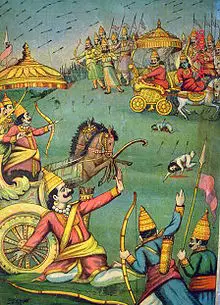
Pic: The most compelling image of Bhishma’s life where Sri Krishna was about to fight with Bhishma pitamah despite his intent of not fight this war, such was the prowess of Bhishma Pitamah.

Bhishma forcing Krishna to take up the wheel of a chariot, despite the oath that he would not pick arms in the war.


Drona

Drona – A respectable teacher and a fearsome warrior from Mahabharata

I am going to write something about another important character from Mahabharata, Drona. Drona was the Guru (Teacher) of Kauravas and Pandavas. He was a well known warrior of his times and being his disciple was a matter of pride. Though he has his flaws, for example he was partial towards Arjuna as when he met an equally gifted archer in form of Ekalavya, he did not hesitate and asked for his thumb as Gurudakshina, to ensure that Arjuna remains the best archer in their times.
 
Nevertheless, prowess of Drona as a warrior or fighter cannot be questioned, such was his effect that Krishna resorted to some less than honourable tactic to render him useless on fifteenth day of the Mahabharata war. This also led to the only blemish on Yudhisthir, who lied(partially) only once in his lifetime. Drona was particularly fond of his son Ashwatthama and Krishna used his name as bait for Drona. Here is the full story of Drona, The great warrior.
 
In the epic Mahabharata, Drona or Dronacharya is the royal guru (teacher) to the Kauravas and the Pandavas. He was a master of advanced military arts, including the devastras. Arjuna was his favorite student. Drona’s love for Arjuna was only second to his love for his son Ashwatthama.
 
Drona was born a brahmin, son of Bharadwaja, in modern day Dehradun (a modification of dehra-dron, a clay pot), which implies that he was not gestated in a womb, but outside the human body in a Droon (vessel).

Birth of Drona

The story of Drona’s birth is recounted dramatically in Mahabharat, Book I: Adi Parva, Sambhava Parva, Section CXXXI. Sage Bharadwaja went with his companions to the Ganges to perform his ablutions. There he beheld a beautiful apsara named Ghritachi who had come to bathe. The sage was overcome by desire, causing him to ejaculate and captured the fluid in a vessel called a drona, and Drona himself sprang from the fluid thus preserved. Drona would later boast that he had sprung from Bharadwaja without ever having been in a womb.
 
Drona spent his youth in poverty, but studied religion and military arts together with the then prince of Panchala, Drupada. Drupada and Drona became close friends and Drupada, in his childish playfullness, promised to give Drona half his kingdom on ascending the throne of Panchala.
 
Drona married Kripi, the sister of Kripa, the royal teacher of the princes of Hastinapura. Kripi and Drona had Ashwathama as son.
 
Learning that Parshurama was giving away his fruits of penance to brahmanas, Drona approached him. Unfortunately by the time Drona arrived, Parasurama had given away all his belongings to other brahmanas. Taking pity upon the plight of Drona, Parasurama decided to impart his knowledge of combat to Drona.
 
For the sake of his wife and son, Drona desired freedom from poverty. Remembering the promise given by Drupada, he decided to approach him to ask for help. However, drunk with power, King Drupada refused to even recognise Drona and humiliated him by calling him an inferior person.
 
In the Mahabharata, Drupada gives Drona a long and haughty explanation of why he is rejecting him. Friendship, says Drupada, is possible only between persons of equal station in life. As a child, he says, it was possible for him to be friends with Drona, because at that time they were equals. But now Drupada had become a king, while Drona remained a luckless indigent. Under these circumstances, friendship was impossible. However, he said he would satisfy Drona if he begged for alms befitting a Brahmin rather than claiming his right as a friend. Drupada advised Drona to think no more of the matter, and to be on his way. Drona went away silently, but in his heart he vowed revenge.
 
Dronacharya’s legend as a great teacher and warrior exceeds Hindu mythology by strongly influencing Indian social traditions. Drona inspires great debates about morality and dharma in the Mahabharata epic.

Drona, the teacher

Drona went to Hastinapura, hoping to open a school of military arts for young princes with the help of the king Dhritarashtra. One day, he saw a number of young boys, the Kauravas and Pandavas gathered around a well. He asked them what the matter was, and Yudhisthira, the eldest, replied that their ball had fallen into the well and they did not know how to retrieve it.
 
Drona laughed, and mildly rebuked the princes for being helpless over such a plain problem. Yudhisthira replied that if he, the brahmin, could retrieve their ball, the king of Hastinapura would provide all the basic necessities to him for life. Drona first threw in a ring of his, collected some grass blades, and uttered mystical Vedic chants. He then threw the blades into the well one after another, like spears. The first blade stuck to the ball, and the second stuck to the first, and so on, forming a chain. Drona gently pulled the ball out with this rope of grass.
 
In a feat that was even more amazing to the boys, Drona then chanted Vedic mantras again and fired a grass blade into the well. It struck within the center of his floating ring and rose out of the well in a matter of moments, retrieving Drona’s ring. Excited, the boys took Drona to the city and reported this incident to Bhishma, their grandfather.
 
Bhishma instantly realized that this was Drona, and his prowess exemplified, asked him to become the Guru of the Kuru princes, training them in advanced military arts. Drona then established a school near the city, where princes from numerous kingdoms around the country came to study under him.
 
Of all the Kaurava and Pandava brothers training under Drona, Arjuna emerges as the most dedicated, hard-working and most naturally talented of them all, exceeding Drona’s son Ashwathama as well. Arjuna assiduously serves his teacher, who is greatly impressed by his devoted pupil.
 
Arjuna surpasses Drona’s expectations in numerous challenges. When Drona tests the princes’ alertness and ability by creating an illusion of a crocodile attacking him and dragging him away, most of the princes are left dumbfounded. But Arjuna swiftly fires arrows that slay the illusionary animal, and Drona congratulates Arjuna for passing this test. As a reward, Drona gifts Arjuna the super-powerful divine weapon of Brahma known as BRAHMASIRIVAS. However, he tells Arjuna not to use this irresistible weapon against any ordinary warrior. This weapon had a sharp edge surrounded below by 3 heads of Lord Brahma. In another challenge, Drona gives each prince a pot to fill with water and swiftly return.
 
Whoever returns fastest would receive instruction in some extra special knowledge. He gives his son Ashwathama a wide-necked pot unlike the other’s narrow-necked ones, hoping he will be the first to return. But Arjuna uses his knowledge of a mystical water weapon to fill his pot swiftly and returns first.
 
In a great challenge, Drona sets up a wooden bird upon a tree, and from across the adjacent river, asks the princes to shoot it down by striking its eye. When prince Yudhisthira tries first, Drona asks him what he saw. Yudhisthira replies he saw Drona, his brothers, the river, the forest, the tree and the bird. Drona replies that Yudhisthira would fail and asks another prince to step forward. The others give the same reply, and Drona is disappointed with all. But when Arjuna steps forth, he tells Drona that he sees only the eye of the bird and nothing else. When Drona excitedly asks him to continue, Arjuna replies that he saw only the bird’s eye. Drona asks him to shoot, and Arjuna strikes the bird down in the eye.
 
Drona had advised the chefs of the palace not to serve food to Arjuna in the dark. However, one night, it so happened that Arjuna was served food in the dark. He subtely observed that he was able to eat food in dark. By practice, hands would reach one’s mouth even in darkness. This striked Arjuna to practice archery in darkness. He begins training by night to use his weapons in absolute darkness, and steadily achieves a great level of skill.
 
Drona is greatly impressed by Arjuna’s concentration, determination and drive, and promises him that he will become the most powerful warrior on earth. Drona gives Arjuna special knowledge of the devastras that no other prince possesses.

Drona and Ekalavya

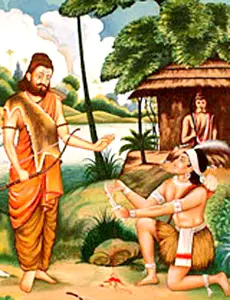
Ekalavya is a young prince of the Nishadha tribes, who comes to Drona for instruction. Drona rejects him on account of him not belonging to the Kshatriya varna (caste). Ekalavya is undeterred, and entering a forest, begins study and practice by himself, having fashioned a clay image of Drona and worshiping him. Solely by his determination, Ekalavya becomes a warrior of exceptional prowess, at par with the young Arjuna. One day, a dog barks while he is focused upon practice, and without looking, the prince fires arrows that seal up the dog’s mouth while not causing any harm. The Pandava princes see this dog running, and wonder who could have done such a feat. They see Ekalavya, who announces himself as a pupil of Drona.
 
Arjuna is worried that his position as the best warrior in the world might by usurped. Drona sees his worry, and visits Ekalavya with the princes. Ekalavya promptly worships Drona. Drona is angered by Ekalavya’s unscrupulous behavior, claiming to be Drona’s student despite his rejection. He is also worried that if Ekalavya maintained this level of skill, he would one day become warrior par-excellence than himself. The more important and personal reason seems to have been his partiality towards Arjuna. Drona asks Ekalavya for a dakshina, or a deed of thanks a student must give to his teacher upon the completion of his training. Drona asks for Ekalavya’s right thumb, which Ekalavya unhesitatingly cuts off and hands to Drona, despite knowing that this would irreparably hamper his archery skills.
 
Ekalavya giving his thumb to his teacher, Drona, in Mahabharat

Drona and Karna

Drona similarly rejects Karna, as he does not belong to the Kshatriya caste. Humiliated, Karna vows to exact revenge. He obtains the knowledge of weapons and military arts from Parasurama, by appearing as a Brahmin, and challenges Arjuna in the martial exhibition. Thus, Drona inadvertently laid the foundation for the Karna’s great rivalry with Arjuna.

Drona and Drupada – the rivalry

On completing their training, Drona asked the Kauravas to bring Drupada bound in chains. Duryodhana appoints Vikarna, the best warrior among the Kauravas, as the army commander. Then he, Dushasana, Sudarshana, Yuyutsu, Vikarna and the remaining Kauravas attack Panchala with the Hastinapur army. They fail to defeat the Panchala army, whereupon Drona sent Arjuna and his brothers for the task. The 5 Pandavas attacked Panchala without an army. Arjuna captures Drupada as ordered. Drona takes half of Drupada’s kingdom, thus becoming his equal. He forgave Drupada for his misdeeds, however Drupada burnt in the desire for revenge and performed a yagna to have a son who would slay Drona and a daughter who would marry Arjuna. His wish was fulfilled and thus was born Dhristadyumna, the slayer of Drona, and Draupadi, the consort of the Pandavas.
 
Drona strongly condemns the wicked prince Duryodhana and his brothers for their abusive treatment of the Pandavas, and for usurping their kingdom by sending them into exile. But being a servant of Hastinapura, Drona is bound by duty to fight for the Kauravas, and thus against his favorite Pandavas.
 
Drona is one of the most powerful and destructive warriors in the Kurukshetra War. He is an invincible warrior, whom no person on earth can defeat, and he single-handedly slays hundreds of thousands of Pandava soldiers with his powerful armory of weapons and incredible skill. After the fall of Bhishma, he becomes the Chief Commander of the Kuru Army.
 
Drona had been the preceptor of most kings involved in the war, on both sides.
On the 13th day of battle, the Kauravas challenge the Pandavas to break a wheel shaped battle formation known as the Chakravyuha. Drona as commander forms this strategy as he knows that only Arjuna and Krishna know how to penetrate it. He asks the king of the Samshaptaka army to distract Arjuna and Krishna into another part of the battlefield, allowing the main Kuru army to surge through the Pandava ranks.
 
However, Arjuna’s young son Abhimanyu is able to penetrate the formation. However, he is trapped when Jayadratha, the king of Sindhu holds the Pandava warriors following him at bay. Abhimanyu does not know how to get out of the Chakra Vyuha, but goes upon an all-out attack on the Kuru army, killing tens of thousands of warriors single-handedly. He even holds Karna and Drona himself at bay. Amazed at his prowess and courage, he is likened by the Kurus as his father’s equal in greatness.

Drona’s role in death of Abhimanyu in Mahabharata

However, his army facing decimation, Drona asks Karna, Dushasana and others to simultaneously attack Abhimanyu, to strike down his horses, his charioteer and to disable his chariot from different angles. Left without support, Abhimanyu begins fighting from the ground, whereupon all the Kuru warriors simultaneously attack him. Exhausted after his long, prodigious feats, Abhimanyu is weakened and grabs one of the wheels of his chariot and blocking all the attacks, but is eventually killed with the stabbing of seven swords, simultaneously. This was a low moment in the Mahabharata, which paved the way for many more incidents where Dharma was not followed.
 
All this was an extreme violation of the rules of war, whereby a lone warrior may not be attacked by more than one, and not at all if he is disabled or without chariot. This devious murder of his son enrages Arjuna, who swears to kill Jayadratha, whom he sees as responsible for his son’s death. If he failed to do so the next day, he would step into fire and commit suicide.
 
Drona lines up the entire Kuru army, with millions of its soldiers in front of Arjuna to thwart his mission. But Arjuna exhibits his full prowess, and by the end of the day has killed more than a million warriors single-handedly. With the help of Krishna, he slays Jayadratha in the nick of time. But on the whole, Arjuna devastates the entire Kuru army dramatically in just one day of fighting.
 
In the war of Mahabharata, Yudhisthira is targeted by Drona to be captured. For this plan to be successful, Duryodhana invites King Bhagadatta, son of the great asura Narakasura to fight against the Pandavas. Bhagadatta was the king of Prajokiyatsa, modern day Burma. As Krishna had killed Narakasur, Bhagadatta agreed to join the Kauravas. But, in spite of Bhagadatta’s support, Drona fails to capture Yudhistra alive. The Kuru commander and preceptor is however killing hundreds of thousands of Pandava warriors and thus advancing Duryodhana’s cause.

Drona, Brahmadanda and death

On the 15th day of the Mahabharat war, Drona, instigated by King Duryodhana’s remarks of being a traitor, uses the Brahmadanda. This spiritual divine weapon contained the power of the seven greatest sages of Hinduism. Drona had neither imparted the knowledge of this divine weapon to either Ashwattama or Arjuna. Thus, he proves unconquerable on the 15th day of Mahabharat war. Krishna asks Yudhisthira to proclaim that Drona’s son Ashwathama has died, so that the invincible and destructive Kuru commander would give up his arms and thus could be killed. Bhima proceeds to kill an elephant named Ashwathama, and loudly proclaims that Ashwathama is dead.
 
Bhima kills Ashwaththama, the elephant
Drona knows that only Yudhisthira, with his firm adherence to the truth, could tell him for sure if his son had died. When Drona approaches Yudhisthira to seek to confirm this, Yudhisthira tells him that Ashwathama is dead…, then, ..the elephant, but this last part is drowned out by the sound of trumpets and conchshells being sounded as if in triumph, on Krishna’s instruction.
 
Yudhisthira cannot make himself tell a lie, despite the fact that if Drona continued to fight, the Pandavas and the cause of dharma itself would lose. When he speaks his half-lie, Yudhisthira’s feet and chariot descend to the ground momentarily. Drona is disheartened, and lays down his weapons. He is then killed by Dhristadyumna. This was the only incident in Mahabharat, when Yudhisthira spoke a lie. This caused his chariot to touch the ground, otherwise it always remain above the ground.
 
It is said that Drona’s soul, by meditation had already left his body before Dhristadyumna could strike. His death greatly saddens Arjuna, who had hoped to capture him alive. Thus the great teacher from Mahabharata, has met his end.
Dhrishtdyumna killing Drona (The Teacher) in the battle of Mahabharat

Karna from Mahabharata


Karna – The most virtuous warrior

In Indian mythology, I don’t come across anyone who is as gifted as Karna, and at the same time, most unfortunate as well. He had everything, yet he ended up having nothing. The reasons, one may argue would his deeds, or the company he kept,but at the same time, we must think that he had to accept what he was given to him, god or if we want this to put more correctly, Ved Vyasa, did not give him too many choices.

To start with, being the eldest son of Kunti, he should have been the king, but her curiosity proved to be the undoing of this person. The price which he had to pay for his mother’s curiosity is overwhelming. He was the best warrior amongst the all Pandavas, he had the Kavach and Kundal to prtotect him, but even the gods conspired against him.

Sometimes we wonder, why Surya just chose to warn him and not to protect him, as Indra have done for Arjun. Even he had left him to fight against the gods. Here lies the ultimate curse, a mere mortal cannot think to win against the gods, and if he tried too, then there were curses to ensure that he failed. There was one from his teacher, which proved to be undoing of this great man. On the other hand, Drona, made sure that Arjun remained the best archer in the world and went out of way to ask for Eklavya’s thumb.

Even in the battlefield, his charioteer Shalya, use to praise his opponent Arjun, where do you heard such kind of odds against a man.

The only person who probably have recognized Karna’s prowess correctly was Shri Krishna, and he did salute him in the battlefield, much to the amusement of Arjun. Nevertheless, Karna comes across with a character which is hard to find. I would say that he did not die for his weaknesses, but paid for other’s fallacies. Who says that this earth is a great place to live?

Family of Danveer Karna – Vrushali and Vrishketu

Karna was the eldest son of Kunti and Lord Surya. There is not much available about his family, but following briefly tells about the family of this great archer, the rashmirathi.

Karna and Kunti
Karna and Kunti
In some texts, Vrushali has been names as the wife of the great warrior Karna, but there is not much material available on her. The son of Karna, Vrishketu is mentioned more frequently and it is also known that Pandavas developed good liking towards him, especially Arjuna.
Karna had two wives- Vrushali- from whom he had seven sons – and Supriya- a friend of Bhanumati. Bhanumati was the wife of Duryodhana. Vrushali committed sati on Karna’s funeral pyre.

Vrishketu and other sons

Vrishketu was Karna’s only son to survive the horror of the Kurukshetra war. He later came under the patronage of the Pandavas.  Vrishketu accompanied both Bhima- to acquire the sacrificial horse and Arjuna, where he famously fought – (and was killed by) Babruvahana.

Shri Krishna’s first response was to revive Vrishketu with the magical Nagmani and only then turn his attention to Arjuna. During that campaign, Vrishketu married the daughter of king Yavanaath, probably a King in the west. It is recorded that Arjuna developed a great affection for his nephew Vrishketu and trained him to be one of the best archers in the world.

Mahabharata  mentions the names of Karna’s seven sons – Vrishasen, Sushen, Bhanusen, Satyasen, Prasenjit and Satyasandh, and Vrishketu.

Out of these, four of them were killed by Pandavas. Vrishasen was killed by Arjun, who contrasted the situation with Abhimanyu and told Karna that just as he killed Abhimanyu when Arjun wasn’t there to protect him, Arjun would kill Vrishasena despite Karna’s presence, and went on to do just that. The next day, Nakula was involved in a battle with Bhanusen, Sushen and Satyasen, and killed them.

In some texts, this is mentioned that one of Karna’s son was killed during the chaos, which was followed after Draupadi’s swayamvar.

Stories of Karna

Karna is known for his helping nature and he never turned anyone back when someone asked for anything from him. Following are the incidents which reflect upon this virtue of him and fittingly, he is also known as Danveer Karna.

Kavach and Kundal

He was born with Kavach and Kundal and thus was impregnable. There was no way he could be parted with these things. Before the war of Mahabharata, Indra thought of a way to do that. Indra was the father of Arjuna. He knew that eventually, there would be a battle between Arjuna and Karna. Karna could not be defeated with Kavach and Kundal on. So Indra disguised himself as a Brahmin and asked for Kavach and Kundal as alms. Karna was forwarned by Surya. Still, he happily gave away the things which was asked of him. In return, Indra gave him the “ekaghni”, which has the power to kill anyone.
Karna born with Kavach and Kundal
Karna eventually had to use this weapon on Ghatotkacha. Ghatotkahca, the son of Bhima, was proving too much for Kauravas. Shri Krishna summoned him to fight the Mahabharata war. Thus, we can see that Arjuna’s safety was ensured by Indra and Shri Krishna while Karna was fighting this all alone. In way, this virtue of Danveer Karna proved to be his undoing.
Karna with Kavach and Kundal - Mahabharat story
Karna with Kavach and Kundal

 Teeth of gold

While Danveer Karna was dying, Lord Indra and Lord Surya had a fight that whether he was the real Danveer at all. They went to him and asked for alms. Karna said that I am dying and do not have anything to give this to you. Indra and Surya have mentioned that he has teeth of gold. Hearing this, he promptly took out the gold and given to the Brahmins.

Gift of Sons

Perhaps this will not be realized in first hand, but Kunti was given four sons as a Dan by Danveer Karna. Karna promised Kunti that she will have five sons, as after the mahabharat war, either him or Arjuna will be alive. This promise was observed by him as Karna had a chance to kill four pandavas but he let them go.  Danveer Karna was indeed a real Danveer!!!

Karna – The respectable character from Mahabharata

Karna – The incomparable

Perhaps the most respectable character in Mahabharata, because he cannot be faulted for his actions. Perhaps the most deserving and worthy who achieved nothing, because everyone around him was plotting against him. From Indra to Krishna. Perhaps the odds were stacked against him, perhaps this was his destiny that his own guru cursed him. Even on the battlefield,everyone was on Arjuna’s side and he lost the duel inspite of fighting better. In my opinion, he was better archer, a better human being who did not get his due.
For those who want to know more about this character, please read Rashmirathi penned by Ramdhari Singh Dinkar. You will not find a better representation of this character. Perhaps I am taking too much time and not going into the details – so here is the story of Karna for you.
Karna is one of the central figures in Hindu epic Mahabharata. He was the first son of Kunti, and was thus brother to the Pandavas, and the eldest of them. Although Duryodhana of the Kauravas appoint him king of Anga, his role in the legend far exceeds the importance of a king. He fought for the Kauravas in the great battle at Kurukshetra.
Karna's chariot stuck in mud
Karna’s chariot stuck in mud

Birth of Karna

The princess Kunti, while young attended to the sage Durvasa for a full year, while he was a guest at her father`s palace. The sage was pleased with her service and so he granted her a boon whereby she could call upon any of the gods through a mantra and the god would grant her a son equal to the god in splendour. Unsure of whether the boon would actually be granted, Kunti, while still an unmarried young girl, decided to test the mantra and called upon Lord Surya, the Hindu deity of the sun. When Surya appeared before her, she was completely overawed. Bound by the power of the mantra, Surya granted her a son as radiant and strong as his father, although she did not want a child. Through his divine power, Kunti retains her virginity and honor. Thus Karna was born. As Surya`s son, Karna is born with an armour (`Kavacha`) and a pair of earrings (`Kundala`) which are dipped in Amrit the nectar of immortality.

Kunti’s embarassment

Kunti was now in the embarrassing position of being an unwed mother. Unable to face the world with her divine child, she placed Karna in a basket and floated him down a river with his jewelry, praying fervently that he would be kept safe.
The child Karna was borne down the river and picked up by King Dhritarashtra`s charioteer, Adhiratha, a suta(meaning son of a Kshatriya man and a Brahmin woman). Karna was raised by him and his wife Radha (not the same Radha who was Lord Krishna`s Companion at Mathura) as their son and named Vasusena (born with wealth), due to his natural set of armour and earrings. They knew something of his parentage by the jewellery he was found with, and never hid from him the fact that he was not their biological child. He was also known as Radheya because of the name of his mother Radha. His younger brother, Shon, was born to Adiratha and Radha after Karna`s arrival.
Birth of Karna and Kunti letting him go away
Karna born with Kavach and Kundal


The bond between Karna and his foster family was one of pure love, respect and affection despite the lack of blood relationship. Adhiratha was honored by Karna in front of all the warrior kind, and Karna lovingly performed his duties as a son and brother within his foster family, despite his rise as king of Anga and the eventual revelation of his true birth.

Training

As he grew into adulthood, Karna sought to be a warrior – being a Kshatriya and divine at that, it is said to have run in his blood. He correspondingly moved to Hastinapura. He approached Dronacharya, who at that time had established his school and was training the Kuru princes, requesting admission into his school. Drona refused to teach him, as he was a sutaputra. Karna realized his caste would continue to be a barrier in his quest for knowledge. He decided eventually to approach Parashurama himself. He did so, and was accepted as a student by Parashurama, who was under the impression he was a brahmin. Karna is spoken of as a diligent student, whose attention and concentration mirrored Arjuna`s. Parashurama trained him, to the point where he declared him his equal in the arts of war and fighting. During his stay in Vishnuavatar Parashurama`s hermitage, Karna befriended many Rakshasas, Yakshas, Gandharvas and Nagas.
As Karna`s training comes to completion, Parashurama learns the truth. One afternoon, when he is tired, he requests Karna to bring a pillow for him, so he may sleep outside in the shade. Karna instead offers him his lap as a pillow. While Parashurama is asleep, an insect comes by, and alighting on Karna`s thigh, bites him. Despite the pain, Karna does not move as it would disturb his Guru. The insect bites deeply into his leg, causing blood to flow out, the warmth and feel of which wakes up Parashurama. He asks Karna how he could withstand the pain and the sight of blood, neither of which brahmins are capable of. He deduces he is a kshatriya, as only they possess the resolve to withstand such pain. He curses Karna, stating that when he requires an astra (divine weapon) the most, he will be unable to recall its incantations. Radheya pleads with him, upon which Parashurama tells him, in a mollified tone, that while his curse is irrevocable, Karna will eventually achieve what he senses as his goal – fame. He tells Karna that eventually, his name will become immortal. 

Parshurama sleeping in Karna's lap
Parshurama sleeping in Karna’s lap
Karna leaves Parashurama`s hermitage, and wanders about for some time. One day, seeing something flash by him, he shoots an arrow at it out of reflex reaction. The arrow kills his target which turns out to be another brahmin`s cow. Its owner, seeing it dead, curses Karna stating that when he is fighting the most crucial battle of his life with his dearest enemy, his chariot wheel will sink and he will be helpless. 

Cursed twice over, Karna returns to his home. He does not tell his family about the curses, merely that his training is complete. Eventually, he decides to seek out a position at the court in Hastinapura.

Tournament of Hastinapur and becoming King of Anga desh

Drona held a tournament at Hastinapura, to display the skills of the Kuru princes, whose training was also complete. Arjuna emerges in this tournament as a particularly gifted archer. Karna, who was at that time a member of the audience, decided to challenge Arjuna, who was fairy complacent about his position and ability. He repeated all of Arjuna`s feats, to the chagrin of Drona and the Pandavas, and the amazement of Duryodhana. To establish a clear winner, Karna challenges Arjuna to single combat. Drona, however refuses Karna his duel, asking first for his clan and kingdom – according to the rules, only a prince may challenge Arjuna who is a prince of the Kuru house. Duryodhana, eldest of the Kauravas, offers Karna the throne of Anga (today`s Bhagalpur in Bihar), so that Karna would be a king and thus eligible to participate in the contest. This act is considered one of the few truly noble actions carried out by Duryodhana. When Karna, who is emotionally overcome at this, asks him what he can do to repay him, Duryodhana tells him all he wants is his friendship. `I want your heart` he tells Karna, to which Karna says it is already his.

Friendship with Duryodhana

This event establishes key relationships in the Mahabharata, namely, the strong bond between Duryodhana and Karna, the intense rivalry between Karna and Arjuna, and the enmity in general between the Pandavas as a whole and Karna.Karna is spoken as a loyal and true friend to Duryodhana. While he was later party to the infamous game of dice to please Duryodhana, he was opposed to it to begin with. Karna disliked Shakuni, and advised Duryodhana continuously to use his prowess and skill to defeat his enemies, rather than deceit and trickery. When the attempt to kill the Pandavas in the house of lac fails, Karna chides Duryodhana in his despondence, telling him the ways of cowards are doomed to failure and exhorting him to be a warrior and obtain what he wants through valour.

As a king, warrior and friend of Duryodhana, Karna became part of the Hastinapura court. He went on to repeat Bheeshma`s actions in bringing the princesses of Kashi to Duryodhana as wives, appearing at the Kashi court, seizing the princesses, and challenging the kings and princes to take them from him if they can.
Another story goes that Karna aided Duryodhana in marrying the princess of Chitragandha(not to be confused with Princess Chitrangada of Manipur). In her swayamvar, the princess rejected Duryodhana and was going to garland some other king when the eldest son of Dhritarasthra forcibly lifted and carried her away. The other kings present at the swayamvar pursued Duryodhana. However, Karna defeated them single-handedly.Among the kings present in the princess of Chitragandha`s swayamvar were Jarasandha, Shishupala, Dantavakra and Rukmi.

As a token of his appreciation of Karna`s valour, Jarasandha is said to have gifted Karna a portion of Magadha (modern day Bihar).

Military Campaign

During the Pandavas` exile, Karna took upon himself the task of establishing Duryodhana as the World Emperor. Karna commanded an army to different parts of the country to subjugate kings and made them swear allegiance to Duryodhana, the king of Hastinapura or else die in battle. While Karna succeeded in all the battles, subjugating even the allies of the Pandavas, the conquest was not permanent. In this military adventure, Karna is stated to have waged wars and reduced to submission numerous tribes including those of the Kambojas, the Shakas, the Kekayas, the Avantyas, the Gandharas, the Madarakas, the Trigartas, the Tanganas, the Panchalas, the Videhas, the Suhmas, the Angas, the Vangas, the Nishadas, the Kalingas, the Vatsa, theAshmakas, the Rishikas (i.e south-western Rishikas located in Maharashtra) and numerous others including mlecchas and the forest tribes.

Generous Karna

Karna is most famous for his generosity, which was said to surpass that of the gods. Following his appointment as king, he took an oath : Anyone who approached him with a request at midday, when he would worship the Sun, would go away with his request fulfilled. He would never let anyone leave empty-handed. This practice contributed to Karna`s fame as well as to his downfall, as Indra and Kunti took advantage of it.
Several stories are told as to Karna`s generosity. One goes that a brahmin, who required sandalwood to cremate his departed wife,  approached Karna for it. It was raining heavily and the brahmin needed dry sandalwood (an alternate version is that there was a shortage of sandalwood in the city). Karna, unable to procure sandalwood from the market, noticed that the pillars of his palace were of sandalwood, and calling for an axe, cut them down to give the brahmin his wood.

Srinivas on August 7, 2012 at 6:52 AM
It seems that stories relating Karna’s Kavach-Kundal and curses are latter day interpolations in Mahabharata to glorify Karna. No doubt that Karna was a great warrior, but not the best warrior of Mahabharata. Arjuna, Bhishma an Abhimanyu were better than him.

If Karna was invincible with his so called ‘natural Kavach and Kundal, why then he lost against Drupada, Gandharva Chitrasena and Arjuna before kurukshetra war, when he had his ‘kavach’ and ‘kundal’ ?

Bhima repeatedly defeated him on 14th day of battle and even on 17th day, before his final encounter with Arjuna. Arjuna had also defeated Karna many times before that encounter. Karna could not save Jayadratha from Arjuna. Suddenly at time of his last battle with Arjuna, he became invincible. It is given in Mahabharata that even Krishna with his ‘sudarshan chakra’ was unable to kill Karna with his natural ‘kavach and kundal’. It sounds absurd.


ReplyRitu on August 22, 2012 at 2:44 PM
Well said. Point well noted. Though there are numerous incidents in Mahabharat itself which sound inconsistent, but they make up for interesting reading for sure. For example, Arjuna beat everybody including Bhishma, Drona, Duryodhana alone before the Mahabharat war, but at the grand stage, all of Pandava’s struggled against Bhishma, Drona, Karna and resorted to some tricks to overpower them.
Reply
Sagar on May 3, 2014 at 12:27 PM
I really disagree with u all that he was not a great warrior, in various occasion he let go 4 other pandvas beside arjun. He was suryaputra he was invincible. Draupadi was afraid of his in swambar because he is able to win the competition. Thus why he insulted him infront of all. He always cheated by gods. Firstly indra and then Krishna. He was trained by parushuram who was the guru of drona and he was the guru of pandava. He have his chances but always walks in the path of truth. And lastly he was the youngest brother of kunti putra and has the all abilities of that all pandvas have.
Reply
Anand Shankar on September 7, 2012 at 5:52 PM

I agree with you Ritu. There are many contradictions in Mahabharata. Mahabharata originally was ‘Jaya Samhita’. It was rewritten many times. The last time this story was told by Ugrashrava around 400 BC. So the core Mahabharata is a real story. It is not a fiction but the History of ancient India. A fiction can not give so much detail of the History and Geography. But there are few interpolations in Mahabharata. I think these interpolations mostly took place in Gupta period to glorify some characters of Mahabharata.

Arjuna defeated kauravas in a surprise attack. Kaurava warriors were perhaps not ready for this battle. They were not expecting Arjuna there. I think kauravas were with a small army at that time. But the situation in Mahabharata was different.


ANYBODY KNOWS WHERE IS KARNA TEMPLES IN INDIA?
  • Its in Kerala and uttar pradesh
  • Presensty Karna is nown as MAHU NAG. In Himachal Predesh there was 108 temples of (Karn) The Lord MAHU Nag
  • You should visit a temple called Manaskamna nath Mandir situated at Nathnagar, in Bhagalpur District of Bihar, India. It is said that King Karna used to give away few kilos of old everyday in alms to poor. And before giving them, he worshipped Lord Shiva at this temple. Nearby the temple you can find the Palace of King Karna, which is known only by few localites.
  • In history, Nathnagar was known as Angh pradesh, of which Karna was the Ruler (Raja). The capital city of Nathnagar was Champanagri which in present days is known as Champa Nagar.


Wednesday, 16 December 2015

Eighteen days of Mahabharata war

Mahabharata war which lasted eighteen days

In the context of Mahabharata, eighteen is an important number. Duryodhana had 11 akshouhini soldiers and Pandavas had 7, making a total of eigtheen. There are eighteen chapters in the epic and last but not the least, the war has lasted for exactly eighteen days.

Mahabharata war
Mahabharata war

Day One and Two – The Grandsire’s amazing skills on display

Uttara and Sweta, sons of Virata, were killed on day one of Mahabharata war. Shalya killed Uttara and Bhishma killed Sweta. This day belonged to Kauravas.
Second day belonged to Pandavas and Satyaki killed Bhishma’s charioteer. Bhishma dazzled in Kurukshetra and Yudhishthira was forced to thinking that how would they conquer this army which has warriors like Bhishma.
Uttara - prince of Virata
Uttara – Prince of Virata

Day Three – Day Eight (Bhima kills few Kauravas)

On day three, Bhishma killed many soldiers of Pandava army.  
On fourth day, Bhima killed eight brothers of Duryodhana. 
Day eight spelled some misery for pandavas, as Arjuna’s son Iravan was killed.

Day Ten (Bhishma’s downfall)

On ninth day, Shri Krishna lost his patience and intended to attack Bhishma. Bhishma so far was proving too much for pandavas army, but Arjuna pacified him. He devises a strategy to cause Bhishma’s downfall. Interestingly, the secret of his downfall was given by Bhishma only. This was made possible by Shikhandi facing him and Arjuna using Shikhandi as shield. (Tenth day). Pandava’s chances only improved after Bhishma was removed from the equation.
Bhishma downfall
Bhishma’s  downfall

Day Twelve and Thirteen – Chakravyuha formation and death of Abhimanyu

On Twelfth day, Susharma engaged Arjuna. Susharma was part of the Duryodhana’s plan to capture Yudhishthir to win the war. On thirteenth day, while Arjuna was fighting Bhagdatta and Susharma, Drona made Chakravyuha formation. Nobody in pandavas knew the key to this apart from Arjuna. Abhimanyu knew how to enter but did not know how to come out of it. Once he entered, Jayadrath ensured that no pandava could follow him. Trapped, Abhimanyu fought valiantly before dying in hands of son of Dushasana, Durmashana.

Abhimanyu in Mahabharata war, he was killed on thirteenth day
Abhimanyu fought valiantly
Abhimanyu killed Brihadbala. He also defeated Duryodhana but let him live because Bhima was under oath to kill him. Seeing this, Karna snaps Abhimanyu’s bow from behind while Drona kills Abhimanyu’s horses and charioteer from the front. Then all Kauravas attacked him simultaneously. Dushasana’s son crushed his skull with a mace. However, Abhimanyu killed him with his own mace before dying. He also killed more than half akshouhini’s of Kaurava’s that day.
Jayadratha killed by Arjuna

Day Fourteen and Fifteen – When Arjuna was close to death and Yudhishthrira spoke a half lie

Next day (fourteenth), Arjuna kills 5 Akshouhini’s of Kauravas and Jayadrath after coming to touching distance of death. This could have doomed pandava’s chances of winning the battle had Krishna not intervened. Karna kills Ghatotkacha with Indrastra, this again ensures that one more factor of  Arjuna’s death is taken care of. Satyaki killed Bhurisravas.

On Day fifteen, Drupad and Virata were killed by Drona. This was indeed Drona’s day, as he was decimating pandava’s army with the help of brahmadanda. Bhima killed an elephant, named Ashwaththama, and claimed that Drona’s son was killed. Drona dropped his arms after Yudhishthira confirmed this and was killed by Dhristdyumna.
Dhrishtdyumna killing Drona (The Teacher) in the battle of Mahabharat
Dhrishtdyumna killing Drona

Day Sixteen and Seventeen

On sixteenth day, Dushashana was killed by Bhima. Bhima tore his arm and drank the blood from his heart. Draupadi could finally tie her hairs with the blood from Dushashana’s heart.

Day seventeenth saw the demise of Karna in hands of Arjuna. He was killed in the same way as Abhimanyu, helpless. Earlier that day, Karna spared Sahdev and Arjuna. Nakula, the most handsome of kuru clan, killed Shakuni’s son Uluka. He took this oath during the gambling loss of killing Uluka. Nakula also killed three of Karna sons, Chitrasena, Sushena and Satyasena. Shalya became the commander of Kaurava’s army on seventeenth day of Mahabharat war.
Karna's chariot stuck in mud
Karna’s chariot stuck in mud

Final Day – Eighteenth day of Mahabharata war

On Final day (eighteenth), Shalya,  who acted as the charioteer of Karna, was killed by Yudhishthir. There was a strange ability to him that he would grew more stronger in a battle as the aggression of his enemies grew. Only Yudhishthir could kill the powerful warrior because the eldest Pandava was not a man of aggression. Sahdev killed Shakuni to avenge the events which followed dice game. Seeing his eminent defeat, Duryodhana sought refuge in a lake. Pandavas found him there and Yudhisthira made a mistake. He offered Duryodhana to pick any of the Pandavas for a duel. Duryodhana chose Bhima. Balrama also watched this great duel between strength and agility. Bhima finally breaks Duryodhana thighs which enrages Balrama as this was against the rules of the war. Incidentally, Bhima vowed after the dice game that he would break Duryodhana’s thighs.
Bhima and Duryodhana - Mahabharata (eighteenth day)
Bhima and Duryodhana – Mahabharata

The night of shame – Ashwaththama’s misdeeds

Later in the night, Ashwaththama slays sons of Pandavas while they were sleeping. He also kills Shikhandi and Dhrishtadyumna. Dhrishtadyumna was the commander of Pandavas that day. He also attempted to kill unborn son of Abhimanyu who was saved by Shri Krishna. Ashwaththama was later cursed by Shri Krishna. Ashwaththama was supported by Kritvarma and Kripacharya.

Seven less known facts from Mahabharata

In Indian mythology, we find mention of stories which are not only interesting, but also serve a message/ purpose. Mahabharata is one such epic, where we find these types of topics in abundance. Here are seven captivating stories from the epic Mahabharata from Indian mythology.

1. Arjuna as an eunuch

In Indralok, Arjuna was propositioned by apsara Urvashi, but Arjuna addressed her as ‘mother’, Urvashi was annoyed with the rejection and cursed him that he would become a eunuch. When Indra came to know about the curse, he told Arjuna that the curse would serve him as a boon during the one year stay in hiding and after spending that period he would regain his masculinity.
Arjuna as Brihannala
This proved to be significant in the war of Kurukshetra. After spending 12 years in forest, Pandavas spent the 13th year of exile in cognito, in the court of king Virat. Arjuna made use of the curse and lived as a eunuch named Brihannala.

2. Five golden arrows

As Kauravas were losing the battle of Mahabharata, Duryodhana approached Bhisma one night and accused him of not fighting the Mahabharata war to his full strength because of his affection for Pandavas. Bhisma greatly angered, immediately picked up 5 golden arrows and chanted mantras declaring tomorrow he will kill 5 pandavas with the 5 golden arrows. Duryodhana not having faith in his words asked Bhisma to give custody of 5 golden arrows saying that he will keep them and will return them next morning.

Long back before the Mahabharata war, Pandavas were living in exile in a forest. Duryodhana placed his camp on the opposite side of the pond where Pandavas were staying. Once while Duryodhana was taking bath in that pond, the heavenly prince Gandharvas came to take bath Duryodhana could not tolerate this and had a fight in which Gandharva captured him. On request of Yudhisthir, Arjuna saved Duryodhana and set him free. Duryodhana was ashamed but being a kshatriya, asked Arjuna what benediction of boon would he like Arjuna replied he would ask for the honour gift later when he needed it.
Bhishma downfall
Bhishma’s downfall
It was during that night of Mahabharata war, when Krishna reminded Arjuna of his unsatisfied boon and told him to go to Duryodhana and ask for 5 golden arrows. When Arjuna asked for the arrows Duryodhana was shocked being a kshatriya and bound by his promise he had to give those golden arrows. He asked who told you about golden arrows, Arjuna replied who else other than Lord Krishna.

Duryodhana again went to Bhisma and requested for another five golden arrows. To this Bhishma laughed and replied this is not possible and will of Lord is Supreme and undeniable and whatever happens tomorrow in the Mahabharata war is written long before.

3. Birth of Drona

In Mahabharata, we find strange ways of people being born. Drona was not gestated in a womb, but outside the human body in a droon (vessel). Bhardwaja went with his companion to the Ganga to perform his ablution. There he beheld a beautiful apsara named Ghritachi who had come to bathe. The sage was overcome by desire, causing him to produce reproductive fluid. Bhardwaja captured the fluid in a vessel called a drona and Dronacharya sprung from the fluid thus preserved. Drona would later boast that he had sprung from Bhardwaja without ever having been in a womb. Drona was the teacher of Pandavas and Kauravas and later fought the Mahabharata war from Kauravas side. 

4. Krishna broke his promise


Shri Krishna challenging Bhishma in the war of Kurukshetra
Mahabharata
Before the battle of Mahabharata, Lord Krishna promised that he will not pickup any weapon.On other hand, Grandsire Bhishma promised Duryodhana that he will fight like a lion and will kill Arjuna or will make Lord Krishna breaking his promise. There was an intense battle between Arjuna and Bhisma and Arjun being powerful still was no match for Bhisma. When Bhisma shot arrow which cut Arjuna armour and his gandiva bow. Arjuna was helpless before the wrath of Grand sire. As Bhisma was about to kill Arjuna with his arrow Lord Krishna could not tolerate his devotees plight and he immediately threw down the chariot rein and jumped off the chariot onto the battle field and lifted a chariot wheel and charged Bhisma determined to send him to death. Arjuna tried to stop Lord krishna but Lord says that in order to protect my devotee, I must break my own promise.

5. How Shri Krishna ended up on Pandavas side in Mahabharata war

Duryodhana and Arjuna both went to Dwarka to meet Krishna in order to seek his support for Mahabharata. Duryodhana was first to reach Dwarka. Satyaki informed that Krishna was asleep. Both Duryodhan and Arjuna entered Krishna’s bedroom. Duryodhana who was first to enter the room sat on a seat at the head of the bed on which Krishna was asleep. Arjuna went to the foot of the bed and stood there with hand folded. When Krishna got up he saw Arjuna first who was standing at his foot. Duryodhana said that as he came first so it was fair that Krishna should join Kauravas.
Duryodhan, Arjun and Shri Krishna
On this, Krishna smiled and said as he saw Arjuna first when he got up so it is also fair that he should help both Kauravas as well as Pandavas. So on one hand was his famous Narayani army, and on other hand was he himself alone and shall not yield any weapon. Then he added that dharma demands that the younger should have the first choice. So Arjuna was given the first chance, he fell at the feet of Lord Krishna with tears in his eyes he chose him. Duryodhana was very happy with the decision. Shri Krishna later became the Arjuna’s sarathi during the war of Mahabharat.

6. Yudhishthir firm adherence to truth

Yudhisthir was very well known for his firm adherence to truth. But, in the battle of Mahabharata, Drona, who was Kauravas commander was killing thousands of Pandavas warriors Krishna made a plan to tell Drona that his son Ashwathama has died, so that Drona would give up his arms and could be killed easily.
Bhima kills Ashwaththama, the elephant
The plan was set in motion when Bhima killed an elephant named Ashwaththama and loudly proclaimed that Ashwaththama was dead. Drona approached Yudhisthir for confirmation because he was the only person who could tell him the truth.Yudhisthir who could not make himself tell a lie inspite of the fact that if Drona would continue fighting pandavas and the cause of dharma would have been lost. Yudhisthir added ‘praha kunjara ha’ which means he is not sure whether man of elephant has died. Krishna knowing this that Yudhisthir would be unable to tell lie, had all the warrior beat war drum and cymbals to make as much noise as possible so that the words ‘praha kunjara ha’ were lost. Drona was disheartened and laid down his weapons. He was later killed by Dhristadyumna.
After speaking this half lie, Yudhisthir feet and chariot descended to the ground.

7. End of Jayadrath

krishna and arjun
Jayadrath was granted a boon by Lord Shiva to hold the pandavas brother at bay for one day in battle – except for Arjun who was protected by Lord Krishna. In Mahabharat war, Jayadradth was fighting from Kauravas side, he using his boon to stop Pandavas from entering the near-impenetrable chakra viyuh battle formation. When Arjun son Abhimanyu enters the formation he was trapped inside and brutally killed. Arjuna vows to kill Jaydradth the very next day and if he failed he would kill himself. Arjuna killed an entire akshauhini during the day’s battle. At a climatic moment the sun had nearly set and thousands of warrior still separates Arjuna and Jayadrath. Seeing his friend’s plight, Lord Krishna send his Sudarshan chakra to mask the sun creating a solar eclipse thus faking a sunset. The Kauravas warriors rejoiced over Arjun defeat and his imminent suicide exposing Jaydradth from his hiding for a crucial moment. Upon the Lord’s urging Arjun shot a powerful arrow that decapitation Jaydradth. Jaydradth father was a sinful king he had pre cursed the killer of his son that anyone who caused Jaydrath’s head to fall on ground would suffer by having his own head exploded. When Arjun recapitulated Jaydrath he faced death but Lord Krishna intervened he asked Arjuna to shoot his arrow that would carry Jaydradth’s head to his father’s lap when he was sitting meditating in his ashram. Arjuna did the same and shot 3 arrows which carried Jaydrath’s falling head to his father’s lap. when he got up after meditation he didn’t see the head in his lap but caused it to fall on the ground so his head exploded as a result.
Jayadratha killed by Arjuna

Pandavas exile

Unknown and untold incidents from Mahabharata Pandavas exile

Sri Krishna, Rama are the avatars of Vishnu and they have their distinct place among gods of mythology, but the epics Ramayana and Mahabharat gives us a chance to look at the characters of others gods of mythology from a human perpective. They are fallible, they have their weaknesses, but in the end, they overcome the obstacles.

Lord Krishna had played a vital role in shaping the fortunes of Pandavas.  Following interesting incidents are taken from Mahabharata which are related to the period when Pandavs were exiled after their elder brother, Yudhishthira lost a game of chausar to Shakuni, Duryodhana’s uncle.
pandavas_exile
Pic – Indian gods of mythology

1. Bhima and python

One day while the pandavas were in exile, Bhima went in search of food for all of them. looking around in the forest, he saw a cave and entered it. A massive python was sitting near the entrance of the cave. When it saw Bhima, it attacked him and coiled itself round the body. Bhima was helpless and struggled hard to free himself from the python’s grip but his attempt to save himself seemed ineffective. Finally, he got tired and gave up.
Then he asked the python, “Who are you and why have you entangled me without any reason? I have not caused you any harm.” The python replied, “I am your ancestor. In my previous birth I had insulted a sage and was cursed to be a python now i will eat you if you will not answer my questions correctly.”
Meanwhile, back at their hut, rest of the Pandavas began to worry since Bhima had not returned and it was getting dark. Since Bhima was very strong and powerful, they had never imagined that any harm could come to him.
Anxious, they went out to search for him. On the way, they saw many dead animals and their anxiety grew. Finally they reached the mouth of the cave, they saw Bhima struggling to free himself from the python’s grip.
Yudhisthira, who was known to be very wise and answered all questions correctly and freed Bhima from his clutches. Even python was freed from his curse and he thanked Pandavas and ascended to heaven. Above is an interesting incident and not much is mentioned about this. This incident is similar to the Yaksha incident where Yamaraj took a examination of all Pandavas.

2. Pandavas saved Duryodhana

Duryodhana came to the forest where Pandavas were spending their years in exile. He put up his tent near the Pandava’s hut and made fun of them. One day Duryodhana and his companions went to lake for bathing. At that time, Chitrasen , the king of the gandharvas also came to the lake.

There was a fight between them. Chitrasen used his sammohanastra to make Duryodhan motionless and captured him. On hearing this, Yudhisthira sent Arjuna to rescue Duryodhan. Arjuna defeated Chitrasen’s soldiers and rescued Duryodhana. Duryodhana felt very humiliated because his most hated enemies , the Pandavas ,  saved his life. However, he owed his life to Pandavas and promised them to do whatever Pandavas asked. In the war of Mahabaharata, Arjuna used this opportunity and asked for five arrows of Bhishma which were intended to kill Pandavas.

3. Wise Yudhisthira and Yaksha

Once a strange incident occurred with pandavas. One day, a Brahmin came to them and said, ‘’I hang the sticks by which I produce fire for my yajnas on a tree. This morning a stag came and rubbed its horns against the tree. My sticks fell and got stuck in the stag’s horns and the stag ran away with them. I want you to get my sticks back.’’

The Pandavas agreed and went in search of stag. They found it but before they could shoot, it ran away. By now pandavas were very tired and thirsty. hey decided to rest in the shade of the tree. Nakula climbed up the tree to see if there was water around. He saw a pool of water. Yudhisthira asked him to bring water for all of them. Nakula went to the pool, but as he tried to take some water he heard a voice, ‘’This pool belongs to me. Before taking water you will have to answer my questions.’’ 

Nakula was very thirsty and ignored the warning and as soon as he touched the water he fainted.

After some time, Yudhisthir sent Sahdev to look for him Sahdev came to the pool and found Nakul unconscious. He decided to sprinkle some water on his face to awaken him. But as he tried to take water, he heard the same warning. He too ignored the warning and became unconscious. 

Then Arjuna came in search of his brothers. He reached the pool and was very angry to see the state of his brother. He too ignored the warning so fainted.

When Arjuna did not return Yudhisthira sent Bhima, who met with the same fate. 

Yudhisthira was getting worried, so went himself to look for his brothers. When he reached the pool he was very sad to see his brothers lying unconscious. He also tried to take some water from the pool and heard the same voice.

Yudhisthira said, ’’You seem to be a divine being . Please ask me the questions. I will try to answer them.’’

The strange voice asked many questions about religion and Yudhisthira answered them carefully and correctly. In the end voice said I am very pleased with your wisdom. I will bring any one of your brother back to his senses you can choose one of your brother.

Yudhisthira said we are sons of two mother Kundi and Madri. I am Kunti’s son so please bring one of Madri’s son back to his senses. Hearing this reply the voice said you have again pleased me with your impartial judgement. 

Suddenly, Yama the God of death appeared and brought all the four Pandavas back to their senses.

 4. The magic bowl

During exile, one day. Sun god gave a Bowl of Plenty (Akshaypatra) and said, ‘’Give this to Draupadi. Once a day, she can take out as much food as she wants until she herself has eaten. Till then, this bowl will not run empty.
One day, sage Durvasa and his disciples were passing through the forest . they came to the hut and asked Draupadi for some food. Draupadi had already eaten and she knew that the bowl would not yield any more food.
Draupadi did not want to turn away the holy sages without food and prayed to Krishna, who came and said “Give me some food.” 
Draupadi said, “This is no time for jokes, please help me feed the guests.” 
Krishna said, “That is why I asked for food.” 
One grain of rice was left in the bowl, which she gave to Krishna. 
Krishna was satisfied and surprisingly., the guests too were satisfied. They left without asking for food. 
Shri Krishna, among the hindu gods of mythology, have helped pandavas in every enterprise. Here , he treated Draupadi as his sister, how could he let her suffer?

 5. Arjuna search

When Pandavas were in exile, sage Vyas told them, “After your exile, you will have a war with Kauravas. Arjuna should pray Shiva for divine weapons.” 
Arjuna went to mount Kailash and started worshiping Shiva.
Pleased, Shiva disguised himself as a hunter and came to test Arjuna. 
Just then a demon, Mooka, attacked Arjuna in form of wild boar. 
Arjuna shot an arrow and killed it, but he saw another arrow in the body of the boar. 
He said, ‘’How dare to shoot my pray?’’. 
Shiva in the hunter form said,’’ I shot the arrow. This is my prey’’. 
A long fight followed between two and Arjuna became tired. 
He said, “I’ll fight after my prayers”.
Lord Shiva giving Pashupata astra to Arjuna - Mahabharat
Lord Shiva giving Pashupata astra to Arjuna – Mahabharata
Arjuna made a shivling and put a garland around it, but to his dismay, he found the garland around the hunter’s neck. He understood that the hunter was Shiva. Shiva came to his real form and gave him Pashupatastra. After this other gods also blessed Arjuna with many more divine weapons. Varuna , god of wind gave him Varunapash; Yama, god of death gave him Dandastra; Kuber gave him Antardhyanastra; Indra gave him Vajrastra. Here we see that various gods of mythology have helped Arjuna, which helped Pandavas. This teaches us that we should follow the advise of those who are respectful.

6. Arjuna and the Crocodile

During exile Arjun went to an ashram where the sages told him,’’There are five pools of water nere by, where we bathed. But now there is one crocodile in each. The crocodile eats whoever goes in the pools.’’
Arjuna has received a boon from Ulupi, the daughter of king of snakes, that no creature of water could defeat him. 
Arjuna fearlessly went to the pool and pulled the crocodile to the shore. 
Immediately it turned into a beautiful women and said,’’I am Varga, a fairy in Kuber’s court. One day along with four other fairies tried to disturb a sage who was meditating. He cursed us to become crocodiles. He said when a brave warrior will pulled us out of water, the curse would end. "
Thus all fairies were freed by Arjuna and they thanked him.

7 Arjuna and Angaparna

During exile, once pandavas were crossing the river, a warrior came riding in his chariot and shouted,’’ I am Angarparna, a heavenly being. This part of the forest belong to me. You can’t cross the river here.’’ 
Arjuna said, ‘’Sacred river Ganga is nobody’s property.’’ 
After this Arjuna and Angarparna had a great fight, and then Arjuna threw a burning torch on Angarparna’s chariot.  
Angarparna jumped out of his chariot and fainted. When he came to his senses he begged for forgiveness. He then presented Chakshushi, a divine sight by which pandavas could see any thing at any place at any time.

Karna

Karna – the most virtuous but tragic warrior from Mahabharata

Karna was the eldest son of Kunti. He was born before Kunti was wedded, so Kunti had to let him go and He, being the eldest and most deserving, had to live his life in obscurity. The only fault was his timing of birth, where he had no control over. Read some of the fate’s cruelty imparted to him.

1. Curses on Karna

One afternoon,  Parashurama requested Karna to bring a pillow to sleep on under a tree shade. Karna instead offered his lap to his guru. While Parashurama was fast asleep a giant bee stung Karna’s thigh, despite of the severe pain Karna didn’t move so as not to disturb his guru’s sleep. As the bee bored deeper the wound began to bleed.  Parashurama was woken by the blood from Karna’s thigh.
Karna - Drona - Danveer - Kavach Kundal
Karna – The most virtuous warrior from  – Mahabharat

Then Parashurama deduced at once that Karna is a kshatriya and not a Brahmin because a brahmin  can not endure such pain. So, he cursed Karna that all his martial skill including use of Brahmastra would desert him when he needed them most.
This meant that Karna would forget all that he had learned from Parashurama during his hours of crisis. Karna who was unaware of his royal lineage pleaded that any student in his place would do the same and he was son of Vasusena,  a mere charioteer and not a kshatriya.
Parshurama's curse to Karna
Parshurama’s curse to Karna
Though Parashurama regretted cursing him in a moment of anger as his curse was irrevocable. He gifted him a celestial weapon Bhargavastra along with his personal bow called Vijaya and blessed him with everlasting glory and immortal fame.

Karna kills a cow accidentally

Departing from Parashuram’s ashram Karna wandered for some time. On his way he killed a cow that was rushing towards him by shooting an arrow. Incensed by this incident, the brahmin who owned the cow cursed. He said as he had killed a helpless animal, he too would be killed in the same way i.e. when he was most helpless with his concentration being diverted away from his enemy at that crucial moment.

Curse by Bhoomi Devi

Once Karna was riding his chariot in his kingdom of Anga. He encountered a child who was crying over her pot of spilt ghee. On asking her reason, she stated that she feared her step mother would be angry over her carelessness.  Being generous enough Karna told her that he would give her new ghee. But the child insisted that she wanted only the ghee which was mixed with the soil and refused to take new ghee. Taking pity on the girl, took the soil mixed with ghee in his fist and squeezed it with all his might to extract the ghee and pour it back into the pot.During this process, Karna heard the agonised voice of a  women. When he opened his fist he realised it was voice of Bhoomidevi, furious Bhoomidevi chastised Karna for inflicting enormous pain for sake of mere child so, she cursed him that in a very crucial battle of life she would trap his chariot wheel in the same way that he held the fistful of soil.

Thus Karna was cursed on three separate and independent occasions. Unfortunately, each of these curses became operational at the same crucial moment in the kurukshetra war thus making him weapon less, left without chariot and helpless. These three curses are the main reason of his fall.

2. Generous Karna

On the eve of Mahabharat battle, Lord Indra disguised as an old Brahamin went to Karna asked for his Kavach and Kundal in daan (alms) Indra asked for this gift so as to reduce his strength, as he was  apprehensive that Karna by virtue of his phenomenal skill as a warrior would defeat Arjuna. Karna was being cautioned by by Sun God about such move of Lord Indra. But Karna was so great hearted that he could not refuse anyone and inspite of knowing that Indra is playing a trick he parted his kawach and kundal, which were part of his body since birth and made him invincible. Indra was pleased with Karna’s generosity and granted him a vardan (boon) Karna asked for his weapon shakti which can destroy any enemy Indra granted him that on a condition that he can use it only once.
Karna giving Kavach to Indra

When Karna was on his death bed, Lord Indra and Surya had a dispute regarding his generosity. To settle this they disguise as a beggar and asked for alms. Karna responded that he had nothing left with him for them. The beggar replied that he had some gold on his tooth which would be valuable for them. On realizing this fact, Karna took a stone and broke his tooth and gave it to beggar, epitomizing the ‘way of life’ he led.
Karna born with Kavach and Kundal

3. Karna’s promise to Kunti

As the war approached Kunti met Karna to reveal his true identity. Kunti asked him to join Pandavas and become king. Karna stated that he can’t betray his friend Duryodhan. However he promised that he would not attempt to kill any of the Pandavas except Arjuna. Karna knew very well that Arjun is under the divine aegis of lord Krishna and hence invincible. This way he would be able to pay off Duryodhan’s debt while performing the duties of elder brother. So he told Kunti that she could only keep her 5 sons being him or Arjuna.

4. Karna in battle field

Bhisma the commander in chief of Kaurava’s refused Karna to participate in war under his leadership saying that Karna has insulted his guru Parshuram by insulting Draupadi and nobody insulting his guru can fight under my leadership. Bhisma also knew about Karna’s true ancestry and did not want him to fight against his own brothers . Consequently Karna entered the battle field only on 11th day after the fall of Bhisma on 10th day.

5. Birth of Karna

Karna was born before his mother Kunti was married to  prince Pandu. Kunti was granted a boon from sage Durvasa who was very pleased with her service and hospitality. The boon was that she can call upon any God to beget a child. Out of curiosity Kunti still being unmarried wanted to test the power of mantra. She invoked the mantra and called Sun God (Surya), bound by the power of mantra Surya appeared and handed her a son, who was radiant and robust as Surya himself. the baby had a Kavach (armour) and kundal (ear ring) attached to his body. Though Kunti didn’t physically give birth to the baby, she was unwilling to face the world as an unwed mother so she placed Karna in a basket and set him float on the holy river Ganga.
Karna was founded by charioteer, he and his wife Radha raised Karna and named him Vasusena. He was also known as Radheya after her foster mother.
Birth of Karna and Kunti letting him go away

6. Karna as king of Ang Desh

Once Drone held a competition in Hastinapur to find out who is the best warrior among all the princes. Arjuna was the winner At that time Karna came forward and did all that Arjuna could do but he was not accepted as competitor because he was a son of a charioteer. This was a great disrespect which Karna has suffered in front of the public. Kunti was also sitting in the audience was a mute spectator she did not dare to say that Karna was her son. At this time Duryodhan came forward and made him king of Ang Desh. This made Karna a friend and follower of Duryodhan for life.

7. Karna, a loyal friend

On the onset of war when Kunti met Karna and revealed his identity and asked him to take the side of Pandavas he replied that he can’t betray his friend Duryodhana. Krishna also revealed his identity and asked him to join Pandava side. Krishna assured him that being the eldest Pandav he will be given the crown of Hastinapur but, Karna refused this enormous offer for his friend Duryodhan. Though Krishna was sad with his decision but appreciated his loyalty.